 English
 Le français
 Türkçe


When an efficiency class moves up one notch, the electricity bill drops; everyone knows that much. But the decision to upgrade from IE3 to IE4 cannot be made on the phrase "less energy" alone. The real question is this: in which power range, at which running hours and under which load profile does this investment pay for itself? A 0.75 kW motor and a 200 kW motor simply cannot be judged by the same logic. At DRG Motor, the pattern we see across supply requests from many sectors is clear: an upgrade made in the right range pays back within a few years, while the same step in the wrong range turns into a disappointment that stretches across a decade.
Running hours, not power, decide the payback
A motor's annual energy consumption is measured not by its rating but by that rating multiplied by its running hours. The efficiency gap between IE3 and IE4 is usually around one to two percentage points. That small percentage produces a small number on a motor that runs 2,000 hours a year, but the very same percentage becomes a serious sum on a motor that turns nonstop for 7,000 to 8,000 hours. That is why, before any upgrade decision, we ask a single question first: how many hours a year will this motor run?
For a continuously running compressor, fan or pump motor, the efficiency gap flows straight into operating cost. By contrast, on a crane motor that works a few hours a day in an intermittent regime, the same gap stays almost invisible. So the same 22 kW motor can be a sensible IE4 investment in one plant and an unnecessary cost in another. The decision is built on the usage pattern, not on the rating plate.
The maths struggles at small power ratings
For motors between 0.75 kW and 3 kW, the case for an IE3 to IE4 upgrade often rests on a weak argument. In this range the motor already draws little energy; the annual saving created by the efficiency gap rarely exceeds a few hundred kilowatt-hours. The purchase premium of an IE4 motor easily overshadows that small saving. For this reason we recommend upgrading small ratings in only two situations:
- the motor runs more than 16 hours a day, almost without interruption,
- there is a fleet of many identical motors where the small per-unit saving adds up to a meaningful total across the count.
Outside these cases, IE3 is usually a sufficient and balanced choice at small ratings. As a supplier, rather than pushing an unnecessary higher class, we prefer to recommend the right one, because lasting customer relationships are built exactly here.
The real gain hides in the mid-power band
The mid-power band between 7.5 kW and 90 kW is the range where an IE4 investment pays back fastest. These motors usually sit at the heart of the process and run for long hours: air handling units, refrigeration compressors, continuous feed pumps, line drives. In this range a gap of one or two percentage points carries the annual saving well above the price difference. In most scenarios the payback period settles between two and four years, and since the economic life of the motor reaches fifteen years, the remaining years stay in the plant as net gain.
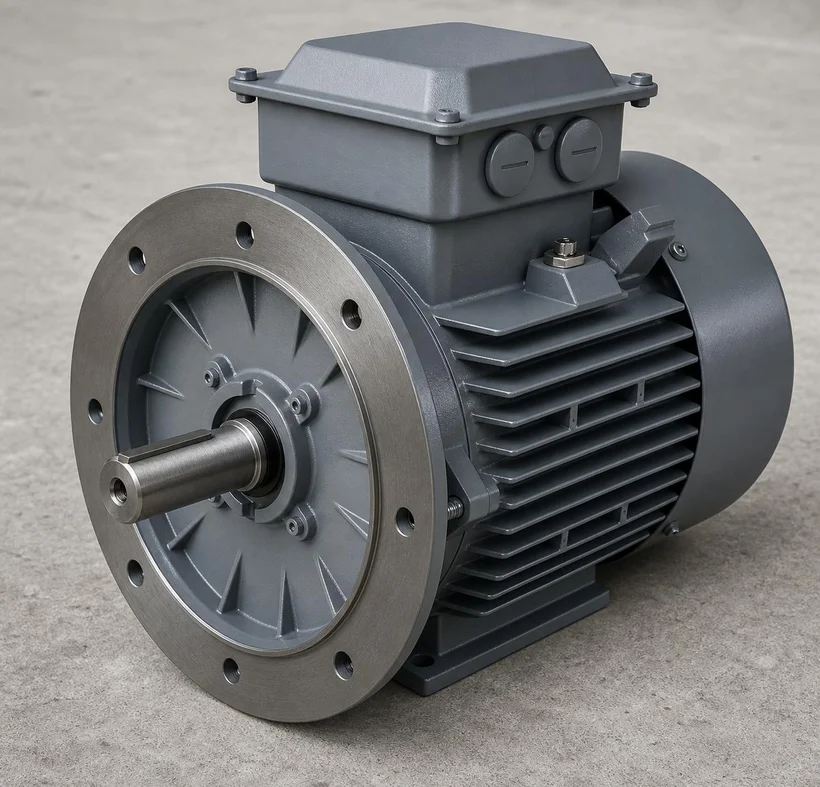
For pump applications working in this band, when choosing a pompa elektrik motoru the bearing arrangement and drive compatibility matter as much as the efficiency class, because at mid power the system efficiency is never the motor alone. A properly matched IE4 motor, together with its drive, can deliver savings beyond expectation.
At large ratings the picture is more delicate
For large motors of 110 kW and above, the upgrade decision is both the most rewarding and the most demanding region. On one hand, because the absolute consumption is very high, even a small efficiency gap maps to large yearly sums. On the other hand, at these ratings IE3 motors already run at high efficiency, and the points gained moving to IE4 are narrower than at small ratings. That is why, at large ratings, we make the call on a measured load profile rather than a rough estimate.
Another critical point at large power is part-load behaviour. Many large motors run below their nominal rating; because IE4 motors hold their efficiency curves better under part load, the real gain can differ from the catalogue figure. For a continuously running large compressor or refrigeration system, an IE4 upgrade is almost always sensible, while for a standby motor idle most of the year the same investment is unnecessary.
Load profile is measured data, not a guess
The quality of an upgrade decision is limited by the quality of the data behind it. When a plant says "the motor runs at full load," our measurements often show the real load sitting somewhere between sixty and seventy percent. That gap may look small, but it reshapes the payback calculation from the start, because both the consumption and the efficiency gained depend on the load point at which the motor actually works. Even a simple reading taken with a clamp meter over a couple of shifts turns an assumption into a decision you can trust.
Getting the load profile right matters most in drive-fed systems. On a fan or pump under variable frequency control, the motor rarely stays at a single point; flow changing through the day moves the motor across different efficiency regions. Because IE4 motors offer a flatter efficiency curve across these regions, the upgrade becomes more attractive in drive-controlled applications. For speed-controlled systems we therefore base the decision on real operating points rather than on simple tables that assume a fixed load.
Replace now or wait for the failure
A question we meet often is whether it is right to replace a working IE3 motor with IE4 straight away. The answer again depends on power and running hours. On a high-rating motor that turns thousands of hours a year, early replacement usually pays for itself; the cost of removing the old motor closes quickly through savings. On a low-rating or lightly used motor, retiring a healthy unit early is not economical; here the right strategy is to plan now for an IE4 replacement when the motor reaches the end of its natural life.
As a supplier we choose to be honest at this point. Telling you to replace every motor today would be the easy sales line, but the right move is to separate the motors that can wait from those that should change. Spreading the upgrade across a schedule protects cash flow and gives priority to the motors with the highest saving potential.
The questions to ask when selecting the efficiency class
To clarify which class is right, we gather these points before starting any upgrade analysis:
- annual running hours and number of shifts,
- average load ratio (how much of its rating the motor actually uses),
- regional electricity unit cost,
- whether a variable frequency drive is in use,
- the motor's remaining expected life and replacement schedule.
An upgrade recommendation made without these five points is no more than a guess. For plants that want to weigh the broader difference between classes in a wider frame, the ie3 ie4 ie5 motor comparison shows step by step which class stands out in which scenario.
Stock, delivery and total cost of ownership
A line often overlooked in the IE3 to IE4 decision is lead time and stock continuity. Selecting the right class matters, but so does being able to source that motor the moment it is needed. As a supplier, this is why we keep common ratings and mounting types on hand; once the upgrade decision is made, the project should not wait for months. When you calculate total cost of ownership, bring purchase, energy, potential downtime and spare availability into the picture.
The most reliable way to clarify in a few minutes whether an upgrade makes sense is a payback analysis built on your real operating data. Reach the DRG Motor team with your power rating, running hours and electricity cost, and let us determine the right efficiency class for your application and prepare a comparative quotation. If IE4 is what you need, from our wide range of IE4 electric motors we offer the model best suited to your application, together with fast delivery options. Whatever power band you are in, we help you make the call with numbers rather than guesswork.